
The Recipe Analogy: Why Your Operational Pain Is Not a People Problem
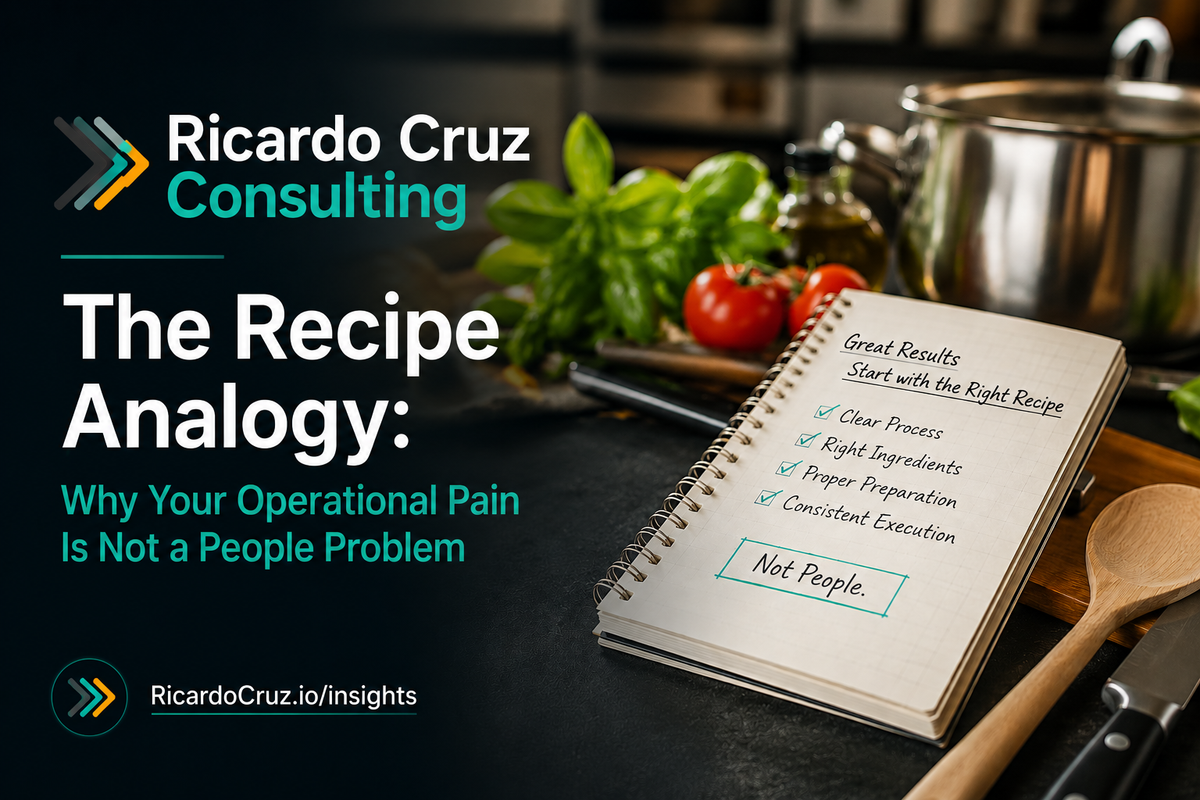
Something went wrong in your operation today. A handoff gets missed. A client does not hear back in time. A report that was supposed to be ready on Monday shows up on Thursday. Your first instinct, if you are honest, is to look for who dropped the ball.
And you will find them. You always do.
But here is the question most business owners never stop long enough to ask: why was it so easy to drop in the first place? Recognizing this can help you feel more confident in your ability to improve your operation.
That gap between the question you ask and the question you should be asking is where most operational pain lives. And until you close it, you will keep solving the same problems with the same tool: a conversation, a correction, a reminder to do better next time. And you will keep wondering why nothing seems to stick.
The Kitchen That Could Not Produce a Consistent Dish
Think about a restaurant kitchen running dinner service on a Friday night.
Orders are coming in faster than the team can turn them. Something goes wrong. A dish goes out cold, a table waits forty minutes, and an allergy gets missed. The chef fires someone. Hires someone new. Runs the same service next Friday. Something goes wrong again.
Now imagine a different kitchen. Same volume of orders. Same level of complexity. But this kitchen has a tested recipe for every dish, a clear station for every cook, and a timing system that tells every person exactly what needs to happen and when. When something goes wrong, and it still will because it always does, the team can trace the failure back to a specific step in a specific process. They fix the step. The dish improves.
Same problem. Completely different approach to solving it.
The first kitchen is managing people. The second kitchen is managing a system.
Most small businesses are running the first kitchen. And they are exhausted from it.
What the Recipe Is Really About
When I work with a business owner for the first time, I almost always hear a version of the same story. Things were manageable when the team was small. Everybody knew everything. Communication happened naturally. Mistakes were rare because everyone could see the whole picture.
Then the business grew. More clients. More team members. More complexity. And suddenly, the thing that used to run on instinct stopped working. Not because the people got worse, but because the system never scaled with the business.
The recipe was never written down. It lived in someone's head.
That is the real problem. Not the missed handoff. Not the late report. Not the team member who dropped the ball. Those are symptoms of a system that was never designed to handle the volume, complexity, or pace the business now demands.
The recipe exists in every business. The question is whether it lives in a system or in the memory of your longest-tenured employee.
Where Businesses Go Wrong When They Try to Fix It
The most common response to operational friction is adding a resource. Hire another person to handle the volume. Add a manager to improve oversight. Bring in a tool to automate the chaos.
None of those fixes work if the underlying process is broken.
Hiring another person into a broken workflow does not reduce the friction. It scales it. Now you have two people navigating the same confusion, making the same errors, and requiring the same corrections. The cost goes up. The problem does not go away.
The same is true for technology. Automation is one of the most powerful tools available to a growing small business. But automating a broken process does not fix it. It just makes the broken version run faster. The errors do not disappear. They multiply, and now they are harder to catch because they are happening at machine speed.
Before you hire, before you automate, or invest in new tools, focus on fixing the recipe. Small businesses can often make impactful changes with minimal resources by starting with process mapping and design.
What Fixing the Recipe Actually Looks Like
This is where the work gets specific, and where most business owners are surprised by how much clarity a well-designed process can create.
Fixing the recipe means mapping what actually happens in your operation using tools like flowcharts or process maps. Not what is supposed to happen, but what does happen. It means identifying every step where the outcome depends on someone remembering something rather than a system prompting them. It means finding the handoffs where information gets lost, the approval steps that create bottlenecks, and the judgment calls that could be made consistent with a clear decision framework.
Then it means designing something better, documenting it, testing it, training your team on it, and building in the checkpoints that let you know when a step is breaking down before it becomes a client-facing problem.
This is not glamorous work. It does not show up in a pitch deck or a product demo. But it is the work that separates businesses that grow with confidence from businesses that grow into chaos.
The Question Worth Asking Today
You do not need a consultant to start asking the right questions. You can start right now.
The next time something goes wrong in your operation, try this before you have the conversation with whoever dropped the ball: trace the failure back one step further than you normally would. Past the person. Past the task. Into the process.
Ask: What would have had to be true about our system for this not to happen? This question can make you feel proactive and confident in your ability to identify systemic improvements.
That question will tell you more about your operation than any performance review, any team meeting, or any new hire ever will.
And if the answer you keep arriving at is that you would need a better process, then you already know what needs fixing.
The recipe is ready to be written. The question is whether you are ready to write it.
Ricardo Cruz is an AI Operations Consultant and Fractional COO based in Carmel, Indiana. He works with small businesses to eliminate operational friction, implement practical AI, and build the systems that let founders focus on the work that actually drives growth. If this post named a problem you are living with, a 30-minute discovery call is a good place to start.
